
Table Of Contents
Eight Stages of Explainer Video Process
The Roles Actually Involved, and Why That Matters to You
Where Clients Most Commonly Slow Down Their Own Project
A Realistic Budget Breakdown Across the Process
What Actually Determines How Long This Whole Process Takes
How Does This Process Adapts Across Different Explainer Video Styles?
Most brands commissioning their first explainer video have no idea what actually happens between sending a brief and receiving a finished file. That gap in understanding causes most of the friction that derails otherwise good projects, unrealistic timelines, feedback dropped at the wrong stage, and budget surprises nobody saw coming. This is the explainer video process laid out in full, stage by stage, so you walk into your next production conversation knowing exactly what you’re buying and why each step exists.
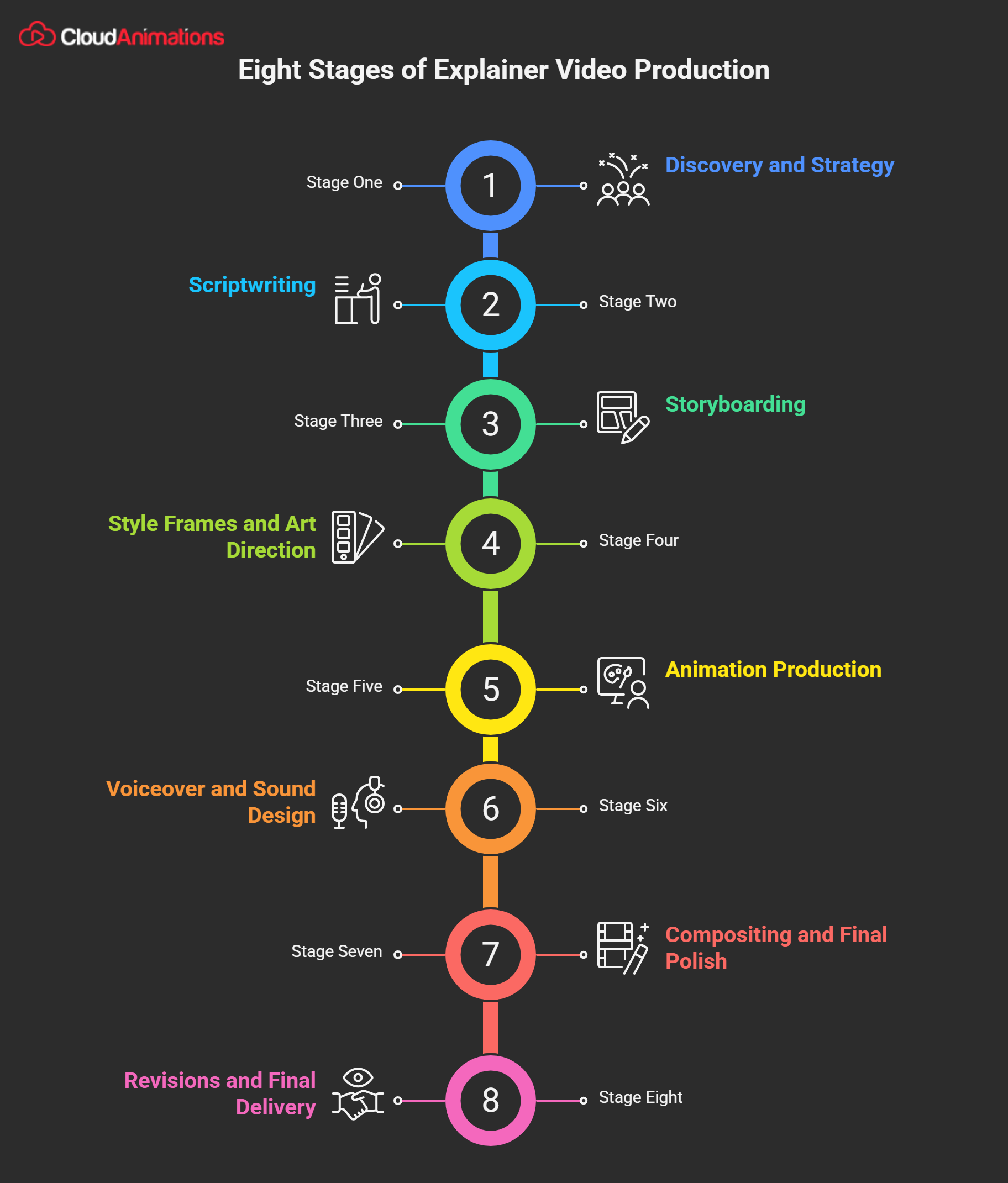
Eight Stages of Explainer Video Process
Stage One: Discovery and Strategy
Before a single word of script gets written, a serious studio spends real time understanding your product, your audience, and the one idea that has to land above everything else. This means digging into your existing marketing materials, talking to your team about the objections your sales process runs into most, and getting brutally specific about who’s actually going to watch this video and what they need to believe by the end of it. Skip this stage, or rush it, and everything downstream inherits the fuzziness. A script without a clear target audience produces generic messaging that resonates with nobody in particular.
A strong discovery phase ends with a one-page creative brief: the core message, the target audience, the tone, and the specific action the video needs to drive. That document becomes the reference point every later decision gets checked against, which is exactly why skipping it tends to cause scope creep and endless revision cycles later in production.
Stage Two: Scriptwriting
The script is the actual foundation of an explainer video production, more than any single visual decision made later. A strong script leads with the viewer’s problem, not your product, introduces the solution at the right pace, and closes with a clear call to action. Most effective explainer scripts run under 150 words per minute of intended runtime, tight enough that every sentence earns its place.
This stage typically involves at least one full revision round with the client before moving forward, since changing a script after storyboarding has started costs meaningfully more than catching a direction problem here.
A genuinely skilled scriptwriter in this space writes for the ear, not the page. Sentences get shorter, rhythm matters more than it does in written marketing copy, and the whole thing needs to sound natural when read aloud by a professional voice actor, not just look good on a slide.
Stage Three: Storyboarding
Storyboarding translates the approved script into a full visual sequence, panel by panel, showing exactly what appears on screen at each moment and how it connects to the narration. This stage is deliberately low-fidelity, rough sketches rather than finished art, because its entire purpose is catching structural and pacing problems while changes are still cheap. A studio that skips a proper storyboard review and jumps straight into animation is gambling that everyone already agrees on a vision that’s never actually been confirmed in writing.
This is the single most important approval checkpoint in the entire process. A client who approves a storyboard quickly and then requests a major structural change during animation should expect that change to cost significantly more and take considerably longer than the same change would have at this stage.
Stage Four: Style Frames and Art Direction
Before full animation begins, most studios produce style frames, fully finished, polished single images showing the exact visual style, color palette, and character or asset design the final video will use. This lets a client sign off on the look and feel of the entire project from a small, manageable sample rather than discovering a stylistic mismatch after dozens of scenes have already been animated in a direction nobody actually wanted.
Stage Five: Animation Production
This is where the bulk of the actual production time gets spent, bringing the approved storyboard and style frames to life frame by frame, scene by scene. Depending on the chosen style, 2D animation, 3D animation, motion graphics, whiteboard, or live action, this stage involves genuinely different technical workflows, but the underlying discipline stays consistent: every scene gets built to serve the script’s pacing, not to show off a flashy technique for its own sake. Most explainer video studios share rough animation passes with the client at this stage for a checkpoint review before committing to final polish.
Stage Six: Voiceover and Sound Design
Professional voiceover narration typically gets recorded once the script is fully locked, matched to the brand’s tone and the target audience’s expectations, a playful startup voice reads very differently than a clinical B2B enterprise voice, and the wrong choice here can undercut an otherwise strong video instantly.
Sound design and music licensing happen in parallel, building the audio layer that gives finished animation its sense of weight and polish. This stage is frequently underestimated in client budgeting, treated as an afterthought when it’s genuinely one of the biggest levers on how professional a finished video actually feels.

Mark Wilson
Mark is a Senior Content Marketer with 7+ years of experience in growing B2B, B2C, e-commerce, SaaS, & Digital Design Brands. He’s a polished writer, SEO geek, optimist at heart & good at playing table tennis.
Get the week’s best
marketing content

Stage Seven: Compositing and Final Polish
All the individual pieces, animation, voiceover, sound design, and music, get combined and fine-tuned together at this stage. Color grading gets applied for visual consistency across every scene, transitions get smoothed, and final timing adjustments get made against the finished audio track rather than the placeholder scratch track used during earlier production.
Stage Eight: Revisions and Final Delivery
Most reliable explainer video studios include a set number of revision rounds within a standard quote, and this stage is where those get used against the fully composited video rather than an earlier work-in-progress cut. Final delivery includes export-ready files formatted for every platform the video will actually run on, web, social, broadcast, and presentation decks, each with slightly different technical requirements, a professional studio handles without the client needing to request it separately.
The Roles Actually Involved, and Why That Matters to You
A finished explainer video looks like the output of one seamless creative vision, but it’s genuinely the product of several distinct specialists handing off work in sequence: a strategist or account lead who owns the brief and keeps the project aligned to your actual goals, a scriptwriter who thinks in narrative structure and spoken rhythm rather than marketing copy, a storyboard artist who thinks in sequence and pacing, animators who specialize in whichever technique the project calls for, a voice director who casts and directs the narration performance, and a sound designer or composer handling the audio layer.
Understanding this division of labor matters for a practical reason: it explains why a genuinely good explainer video costs what it costs, and it tells you what to ask a prospective studio about specifically. A studio that has one generalist doing all of these roles isn’t necessarily bad; small, talented teams do excellent work, but it’s a meaningfully different production model than a studio with dedicated specialists at each stage, and it’s worth knowing which one you’re actually hiring before a project starts.
Where Clients Most Commonly Slow Down Their Own Project
Beyond scattered feedback across multiple stakeholders, a few specific habits reliably add unplanned time to a production timeline. Requesting a completely new creative direction after style frames have already been approved is the single most expensive change a client can make, since it effectively restarts the art direction phase while the clock keeps running on the original schedule. Providing brand guidelines or logo files midway through production, rather than at kickoff, forces rework on anything already built using placeholder or incorrect assets.
And treating the first full cut as a rough draft rather than the near-final product it actually represents, sending back extensive notes at the composited stage that should have surfaced at storyboard, consistently produces the most frustrating and expensive revision cycles in this entire process. None of these mistakes is unusual or embarrassing; they’re common enough that an experienced studio should proactively flag the risk of each one during kickoff rather than waiting for a client to discover them the hard way.
A Realistic Budget Breakdown Across the Process
Understanding roughly how a typical explainer video budget distributes across these stages helps set expectations for where your money is actually going. Discovery, strategy, and scriptwriting together typically represent a meaningful but not dominant share of total cost, front-loaded work that shapes everything else.
Storyboarding and style frames represent a smaller line item individually but an outsized value relative to their cost, since they’re the cheapest insurance against expensive changes later. Animation production is consistently the largest single line item, unsurprising given it’s the most labor and time-intensive stage regardless of the chosen style. Voiceover, music licensing, and sound design typically represent a smaller but non-trivial share that inexperienced buyers frequently underestimate when building an initial budget.
Seeing the breakdown this way makes it clearer why a rock-bottom quote from an unfamiliar vendor should raise real questions, since it’s difficult to cover genuine specialist labor across all these stages at prices dramatically below industry norms without cutting corners somewhere the client won’t notice until the finished product underperforms.
What Actually Determines How Long This Whole Process Takes
A straightforward 60 to 90 second explainer typically runs three to five weeks from kickoff to delivery, assuming reasonably prompt client feedback at each stage. Complex projects, character-heavy 2D animation, detailed 3D work, and multiple stakeholder approval chains can extend meaningfully beyond that range.
The single biggest controllable factor on the client side isn’t the studio’s raw production speed; it’s how quickly and clearly feedback gets consolidated and delivered at each checkpoint. A brief that bounces between five internal stakeholders with conflicting opinions reliably slows a project down more than almost any technical production challenge a studio encounters.
How Does This Process Adapts Across Different Explainer Video Styles?
While the eight stages above hold true regardless of style, the emphasis shifts meaningfully across 2D animation, 3D animation, motion graphics, whiteboard, and live action projects alike. 2D character animation typically demands more time in the style frames stage, since character design and expression range need real exploration before committing to full production.
3D animation shifts weight toward modeling and rigging before animation can even begin, an upfront investment that doesn’t exist in 2D or motion graphics work. Motion graphics, built more around typography, data visualization, and abstract shape language, often move faster through storyboarding since there’s no character performance to choreograph, but demands more precision in timing and rhythm to avoid feeling mechanical.
Live action shifts an enormous share of the process earlier, into pre-production scheduling, location scouting, and casting, work that has no real equivalent in fully animated formats. Knowing which style your project needs before requesting a quote helps set realistic expectations for where in this process your specific timeline will naturally take longer or move faster than the general range.
What Separates a Strong Process From a Weak One?
The studios producing consistently strong explainer videos treat every stage above as a genuine checkpoint, not a formality to rush through on the way to animation. They push back on vague briefs instead of guessing. They insist on storyboard approval before animating a single frame. They budget real time for voiceover casting rather than grabbing whatever’s available. None of that is glamorous, and none of it shows up directly in a finished reel, but it’s the actual difference between a video that performs and one that just looks finished.
See how this full process plays out across real projects, and explore the range of styles this process supports on our Explainer Videos page.
Get your Free 30 Minute strategy
session with an experienced digital animators
Frequently Asked Questions
Q: How long does the full explainer video process typically take?
A standard 60 to 90 second explainer video usually takes three to five weeks from kickoff to final delivery, assuming timely client feedback at each review stage. More complex projects with detailed 3D animation or multiple stakeholders can extend this timeline considerably.
Q: What’s the most important stage in the explainer video process?
Storyboarding is arguably the most important checkpoint, since it’s the last stage where structural or pacing changes remain cheap to make. Changes requested after animation production has begun cost significantly more and take considerably longer to implement.
Q: Do I need to approve every single stage of production?
Most professional studios build in specific checkpoints, script, storyboard, style frames, and a rough animation pass, rather than requiring approval at every micro-step. This balances client control with keeping the overall process moving efficiently.
Q: Why does voiceover casting matter so much to the final result?
The voice carries a huge share of a video’s perceived tone and professionalism. A mismatched voice, too casual for a serious B2B product or too stiff for a playful consumer brand, can undercut an otherwise well-produced video, which is why casting deserves real consideration rather than treatment as an afterthought.
Q: How many revision rounds are typically included in an explainer video quote?
Most studios include one to three revision rounds within a standard quote, applied at specific stages like script, storyboard, and final composited video. Revisions requested outside these included rounds or major structural changes late in production typically incur additional cost.
You Might Also Like
How Explainer Videos Help Businesses?


The Role of AR/VR in Interactive Storytelling for Children

Why Explainer Videos Are a Must-Have for B2C Sales?

Why Explainer Videos Are Effective?

Why Are Creative Explainer Videos for Internal Business Training and Communication Effective?

How Product Explainer Videos Boost Sales and Customer Understanding?

How AI Explainer Videos Are Transforming Complex Concepts into Simple Ideas Creative

What is the Role of Corporate Explainer Videos in Onboarding and Training?
Why Whiteboard Explainer Videos Are Perfect for Complex Ideas?

How do you find the best studio at low costs for explainer videos in the USA?
Give us your e-mail so
we can give you Update