
Table Of Contents
What Forensic Animation Actually Means
Forensic Animation and Legal Animation: How the Terms Relate
From Evidence to Image: How the Reconstruction Is Built
Why Juries Understand More When They Can See It
Where Forensic Animation Is Used
What Separates a Credible Reconstruction from a Persuasive Fiction
A photograph freezes a single instant. A diagram flattens a three-dimensional event onto a page. Testimony asks a jury to build the picture themselves, in their heads, from words alone. For a great many disputes, none of those tools quite captures what actually happened — the motion, the timing, the sequence, the split-second geometry of an event that unfolded in seconds and now has to be understood months later by people who were never there.
Forensic animation exists to fill that gap. It is one of the more misunderstood tools in modern litigation, partly because the word “animation” calls to mind cartoons and film effects. In a courtroom, it means something far more disciplined: a moving reconstruction of an event, built entirely from the evidence of a case, designed to help a judge or jury understand what the record already shows.
This article explains what forensic animation is, how a pile of reports and photographs becomes a defensible visual, where it fits within the broader world of legal animation, and how to tell a credible reconstruction from a persuasive fiction. If you are new to the subject, this is the ground-level explanation with no jargon assumed.
What Forensic Animation Actually Means
A forensic animation is a visual reconstruction of an accident, injury, or incident, created for use in litigation or investigation and grounded in physical evidence and expert analysis. The defining word is “forensic”, meaning it relates to, and is prepared for, a legal proceeding. Everything about it is built to be examined, questioned, and defended.
That single quality sets it apart from ordinary animation. A marketing video succeeds if it looks good and holds attention. A forensic animation succeeds only if it is accurate and if every element on screen can be traced back to something concrete: a measurement, a photograph, a data reading, an expert opinion. Visual polish is welcome, but it is never the point. Accuracy is the point, because opposing counsel will treat the animation as a target and probe it for anything invented, exaggerated, or unsupported.
Forensic animations vary widely in length and ambition. Some run only ten or twenty seconds — a single collision, shown once, from one clear angle. Others stretch to several minutes, walking through a complex chain of events step by step. What stays constant is the discipline underneath: show what the evidence supports, flag what is assumed, and invent nothing.
Forensic Animation and Legal Animation: How the Terms Relate
These two phrases are often used interchangeably, and the overlap is real, but there is a useful distinction. Legal animation is the broad umbrella and any animation prepared for legal use, including timelines, contract-dispute visuals, financial-flow graphics, and process explanations that involve no physical “scene” at all.
Forensic animation is the subset concerned specifically with reconstructing physical events from evidence: a crash, a fall, an injury mechanism, a product failure. Every forensic animation is a legal animation, but not every legal animation is forensic. When people say forensic animation, they almost always mean a reconstruction of something that physically happened, built from the forensic record. Understanding that relationship helps when you are scoping a project or evaluating legal animation services, it tells you which kind of expertise the matter actually requires.
From Evidence to Image: How the Reconstruction Is Built
The most important thing to understand about forensic animation is that it is not drawn from imagination. It is assembled from evidence, in a sequence that keeps the finished visual anchored to the record at every step. Here is how a case file becomes a courtroom visual.
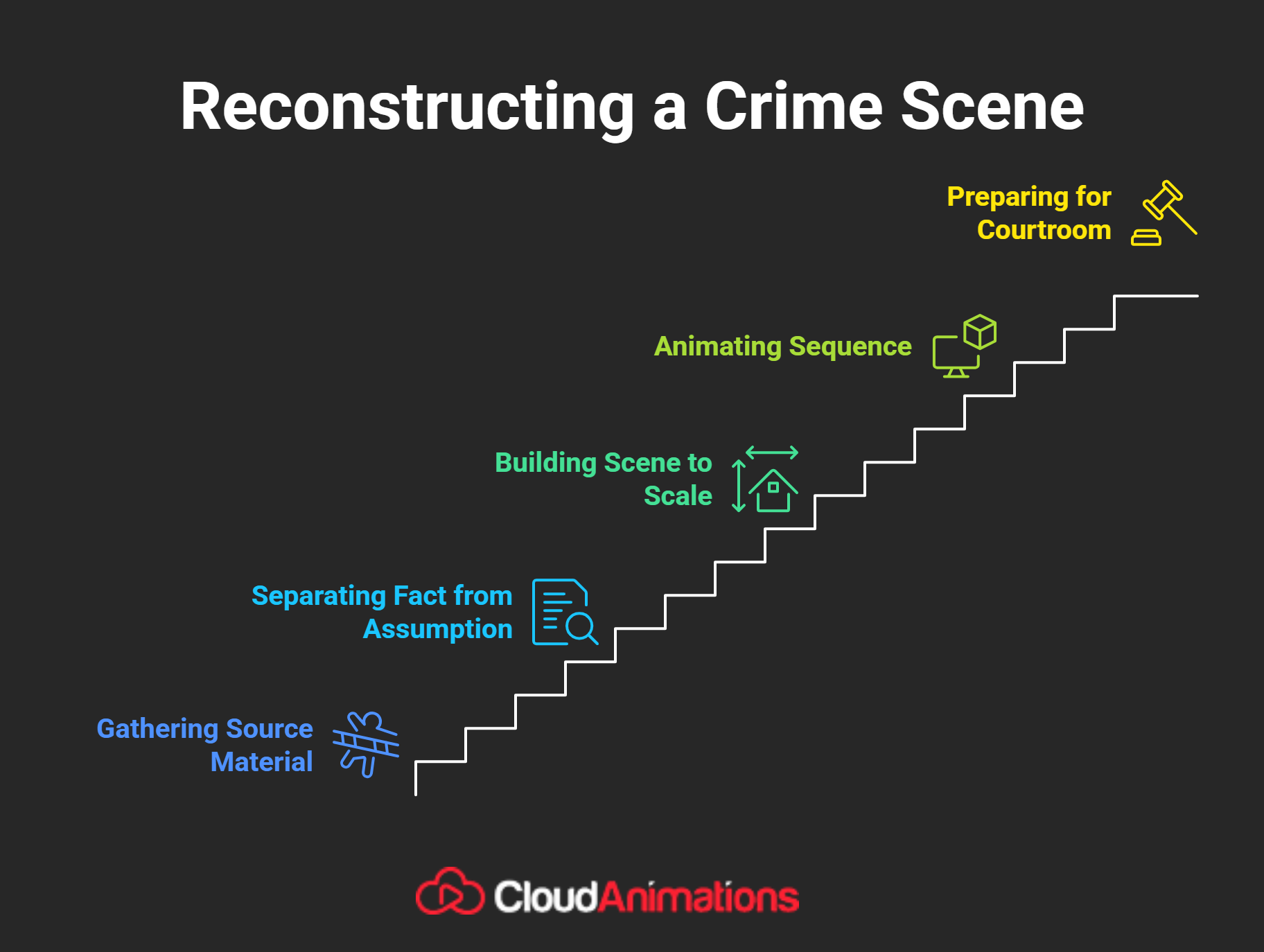
Step One: Gathering the Source Material
Everything begins with inputs; the raw evidence that will control what the animation can and cannot show. Depending on the case, that may include:
- Police reports, incident reports, and scene diagrams
- Photographs and video, including surveillance, dashcam, and bodycam footage
- Scene measurements, survey data, and laser scans of the location
- Vehicle inspection findings and event data recorder “black box” downloads
- Medical records and imaging such as CT and MRI scans
- Deposition excerpts, witness statements, and the analysis of retained experts
The quality of these inputs sets a ceiling on the animation. A reconstruction can only be as reliable as the evidence beneath it, which is why good studios push hard for source material early and refuse to fill gaps with guesswork. When a detail simply is not in the record, the honest answer is to flag it as an assumption, not to paper over it with a confident-looking image.
Step Two: Separating Fact from Assumption
This is the step that separates forensic work from everything else. As the team studies the evidence, every element of the eventual scene is sorted into one of two categories: measured fact or reasoned assumption. The point of impact recorded in a report is a fact. The exact speed of a vehicle where no data exists may be an assumption, derived by an expert from skid marks or crush damage.
A credible reconstruction never blurs the two. Assumptions are documented, reviewed with the legal team and the expert, and where it matters is shown transparently rather than hidden. This discipline is not just ethical housekeeping; it is what lets a witness answer the decisive courtroom question, “What is this based on?” without hesitation.
Step Three: Building the Scene to Scale
With the evidence sorted, the environment is constructed, the roadway, the intersection, the machine, or the human anatomy and modelled to accurate scale using the measurements in the record. Two-dimensional builds suit timelines and sequences; three-dimensional builds come into play when spatial relationships matter, such as a driver’s line of sight or the angle at which two vehicles meet. The choice of dimension follows the facts of the case, not the size of the budget.
Step Four: Animating the Sequence
Only now does motion enter. The sequence is animated to match the evidence and the expert’s analysis, the movement, spacing, and timing that testimony alone struggles to convey. Throughout, the work runs through source checks and version control with the legal team and expert, so that if any frame is challenged later, its basis is documented and traceable. The result is not a dramatization; it is the record, set in motion.
Step Five: Preparing for the Courtroom
Finally, the animation is delivered in formats ready for mediation, deposition, or trial, often accompanied by source packets and slide notes. These let the sponsoring witness lay a clean foundation and walk the jury through the exhibit with confidence. A forensic animation that arrives without this support is only half-finished — the visual and its evidentiary backing are meant to travel together.

Mark Wilson
Mark is a Senior Content Marketer with 7+ years of experience in growing B2B, B2C, e-commerce, SaaS, & Digital Design Brands. He’s a polished writer, SEO geek, optimist at heart & good at playing table tennis.
Get the week’s best
marketing content

Why Juries Understand More When They Can See It
There is a simple reason forensic animation has moved from novelty to mainstream over the past two decades: it works with the way people actually absorb information. A large share of what the human brain processes arrives visually, and jurors retain noticeably more of what they see in motion than what they only hear described.
Consider the difference in practice. An expert can spend twenty minutes describing how a multi-vehicle collision unfolded, who was where, at what speed, with what line of sight, in what order. Even an attentive juror will struggle to hold all of that in mind at once. The same sequence, shown as a clear reconstruction, lands in seconds. The jury is no longer assembling the event from fragments; they are watching it, and they can follow the expert’s testimony as it happens rather than racing to keep up.
This is where forensic animation earns its place. It does not argue the case for you, and it should not try to. It removes the confusion that otherwise stands between the jury and the evidence, so that your strongest facts are actually understood rather than lost in a fog of technical description. Clarity, not spectacle, is the goal — and clarity is what changes how a case lands.
Where Forensic Animation Is Used
Forensic animation is most valuable when a case turns on something a jury cannot easily picture sequence, speed, spatial relationship, or a hidden internal mechanism. A handful of areas account for most of the work.
Accident and Crash Reconstruction
This is the classic use. When liability hinges on timing, speed, road position, or point of impact, an accident reconstruction animation lets a jury watch the crash unfold from scene data and expert analysis rather than piecing it together from testimony. The approach covers everything from a disputed left-turn collision to a nighttime pedestrian strike or a blind-spot trucking case — any matter where the sequence has been buried in words and needs to be shown plainly.
Medical and Injury Visualization
Some of the most persuasive forensic work happens inside the body, where no camera could ever go. Using medical records and imaging, an animation can show how an injury occurred or how a procedure went wrong — translating dense clinical testimony into something a lay juror can follow. Because these exhibits depict internal events supported by an expert’s opinion, the sourcing discipline described earlier matters even more.
Product Failure and Technical Causation
When a product fails, the failure is usually fast, hidden, or both. Forensic animation can reveal the failing mechanism and the hazard it created, step by step, making technical causation teachable to jurors who have no engineering background. Here the reconstruction bridges the gap between a dense expert report and a verdict the jury can actually reason toward.
Beyond the Obvious Cases
The same principles extend to wrongful death matters, premises liability, construction disputes, and criminal defense reconstructions. The deciding factor is never the practice area; it is whether the case turns on something better shown than described. To see how these reconstructions fit within a full-service offering, the legal animation services page lays out the range of matters where a courtroom visual pays for itself in juror comprehension.
What Separates a Credible Reconstruction from a Persuasive Fiction
Because forensic animation is so effective, it draws appropriate scrutiny and it should. The same visual power that helps a jury understand the truth could, in the wrong hands, be used to mislead. Courts are alert to this, which is why a reconstruction has to earn its way in. A few markers separate work that holds up from work that invites an objection.
- It is traceable to the evidence. Every element on screen maps to a specific item in the record. If a detail cannot be sourced, it is flagged as an assumption rather than presented as fact.
- It clarifies rather than inflames. Dramatic sound effects, gore, and emotionally charged camera work are the hallmarks of an exhibit built to prejudice rather than inform and the fastest route to exclusion.
- It is sponsored by an expert. A witness, often the reconstructionist or physician whose opinion it depicts, must be able to testify that the animation fairly and accurately represents their analysis.
- It respects the rules of evidence. Admissibility depends on relevance, fairness, and a proper foundation, and the standard your court applies shapes how the underlying methodology is vetted.
These questions of admissibility deserve a fuller treatment than a single article allows, and they vary meaningfully by jurisdiction. For a deeper look at how the concept sits within the courtroom rules — including the distinction between a demonstrative aid and substantive evidence — the complete guide to legal animation is the natural next read. For now, the shortcut is this: a reconstruction you can defend line by line is an asset, and one you cannot is a liability waiting to happen.
How to Judge a Forensic Animation Provider
If you are considering commissioning a reconstruction — or bracing for one the other side has produced a short set of questions will tell you most of what you need to know. Ask them of any studio, and of any exhibit put in front of you:
- Do they lead with evidence and sourcing, or with showreels and rendering quality?
- Can they explain how they separate measured fact from reasoned assumption?
- Do they build in review cycles with your expert, rather than delivering a finished video in one pass?
- Do they provide source packets and courtroom support so a witness can lay a foundation?
- Do they understand the admissibility standard in your jurisdiction?
A provider who answers these confidently is doing forensic work. A provider who deflects toward how impressive the final product will look is selling something else. The visual craft of a reconstruction is the easy part; the defensibility is the real job, and it is worth choosing a legal animation studio that treats it that way from the first conversation.
Key Takeaways
Forensic animation is, at heart, a translation tool. It takes the sequence, the mechanism, or the injury that already lives in the evidence and makes it visible accurately, transparently, and in a form a jury can follow. The best reconstructions are the disciplined ones: sourced from the record, honest about their assumptions, restrained in style, and backed by an expert who can stand behind every frame.
Understood this way, forensic animation is not about making a case look more dramatic. It is about making it understood, closing the distance between what the evidence shows and what the jury actually grasps. When a matter turns on something people need to see to believe, a well-built reconstruction can change how the whole story lands. If you want to see how that discipline translates into practice, exploring a studio’s legal animation services is the right place to start.
Frequently Asked Questions
- Is forensic animation admissible in court?
Yes, in most cases, though it is not automatic. A forensic animation is usually offered as demonstrative evidence, meaning it illustrates a witness’s or expert’s testimony rather than standing as proof on its own. To be admitted, it generally has to clear three hurdles: a sponsoring witness must confirm it fairly and accurately represents their analysis, it must be relevant to a fact in the case, and its usefulness must not be outweighed by the risk of unfairly prejudicing the jury. Animations tied closely to the evidence are admitted routinely; the ones that get excluded are those that dramatise beyond what the record supports.
- What is the difference between a forensic animation and a simulation?
The distinction turns on what the visual claims to do. An animation depicts what a witness or expert says happened, so its credibility rests on that person’s testimony. A simulation is different: data and physics are fed into software that calculates an outcome, so the model itself is effectively drawing the conclusion. Because a simulation produces a result rather than merely illustrating one, courts apply tougher reliability standards to it, often requiring validation under the Daubert or Frye standard. Most litigation exhibits are animations, not simulations, and a good provider will tell you which one your case actually needs.
- How much does a forensic animation cost?
There is no flat rate, and cost tracks the complexity of the work. Straightforward reconstructions tend to start in the low thousands, while detailed three-dimensional builds for trial commonly run into the tens of thousands, with published ranges spanning roughly $3,000 to $50,000 depending on the source. The main cost drivers are scene complexity, length, how much custom modelling is required, and the number of revision rounds. Notably, rendering is a small share of the total; the bulk of the work goes into gathering evidence, consulting with experts, building accurate models, and revising until the animation matches the record. Any provider quoting a firm price without reviewing your materials is guessing.
- How long does it take to make a forensic animation?
It depends on scope. A simple timeline or sequence can be produced in a week or two, while a comprehensive reconstruction with detailed modelling and multiple expert reviews can take 90 days or more. The biggest variables are the complexity of the scene, how many parties need to review the work, and how quickly you can supply the underlying evidence. Because early involvement can strengthen settlement discussions and leave room for opposing counsel to review the exhibit before trial, it usually pays to commission the work sooner rather than later.
- What evidence is needed to create a forensic animation?
The animation can only be as reliable as the evidence beneath it, so the inputs matter enormously. Common source material includes police and incident reports, scene photographs and diagrams, surveillance, dashcam or bodycam video, scene measurements and LiDAR or laser scans, vehicle inspection findings and event data recorder (“black box”) downloads, medical records and imaging, and the analysis of retained experts. Where a specific detail is not in the record, a credible studio flags it as a stated assumption rather than inventing it, which is exactly what allows the exhibit to survive cross-examination.
- Do forensic animations unfairly influence or bias the jury?
This is the most common objection, and the research is reassuring on it. A study in the International Journal of Legal Medicine found that jurors understood expert testimony noticeably better when it was paired with 3D visual evidence, with comprehension rising from 79% with photographs to 88% and higher with 3D visualizations. Importantly, the same study found no statistically significant effect on verdict outcomes; what improved was understanding, not the direction of the decision. That distinction is why courts allow restrained, evidence-based animations while excluding dramatized ones: the goal is to help jurors comprehend the facts, not to inflame them.
Get your Free 30 Minute strategy
session with an experienced digital animators
You Might Also Like

How Explainer Videos Help Businesses?


The Role of AR/VR in Interactive Storytelling for Children

Why Explainer Videos Are a Must-Have for B2C Sales?

Why Explainer Videos Are Effective?

Why Are Creative Explainer Videos for Internal Business Training and Communication Effective?

How Product Explainer Videos Boost Sales and Customer Understanding?
How AI Explainer Videos Are Transforming Complex Concepts into Simple Ideas Creative

What is the Role of Corporate Explainer Videos in Onboarding and Training?
Why Whiteboard Explainer Videos Are Perfect for Complex Ideas?

How do you find the best studio at low costs for explainer videos in the USA?
Give us your e-mail so
we can give you Update