
Table Of Contents
The Technical Foundation: What is Cel Animation?
The Mechanical Grind: The Cel Animation Process
The Digital Shift: What is Digital Cel Animation?
Use Cases: Why Choose Cel Animation Today?
Iconic Cel Animation Examples Through the Decades
Before the digital revolution turned every creative process into a series of mouse clicks, prompts, and keyboard shortcuts, the world of motion was built on a foundation of chemistry, physical layers, and intense manual labor. We are talking about the era of cel animation. This is the technique that gave us everything from the early triumphs of Walt Disney to the grit of 1980s anime. It is the grandfather of the modern industry, and its DNA still dictates how we perceive movement on a screen today.
If you want to understand why a certain style of 2D motion feels warm, organic, and inherently human, you have to look at the cel animation definition. This is not just a legacy format; it is a philosophy of layers. For the creator, the student, or the brand manager, understanding this process is the key to appreciating the “handmade” aesthetic that is currently making a massive comeback in high-end advertising and cinema.
The Technical Foundation: What is Cel Animation?
Let’s strip away the nostalgia and look at the mechanics. What is cel animation in a technical sense? The term “cel” is short for celluloid. Celluloid is a transparent, thin sheet of plastic. In the traditional workflow, these sheets were the primary canvas for animators.
Unlike a standard piece of paper, a cel is clear. This transparency is the “killer feature” that allowed the industry to scale. By drawing a character on a clear sheet and placing it over a static, painted background, animators only had to redraw the moving parts. They didn’t have to recreate the entire scene for every single frame. This was the first great efficiency in the history of the medium, and it set the stage for every cel animation process that followed for the next century.
A Look Back: Cel Animation History
If you are wondering, ‘when was cel animation invented?’, we have to go back to 1914. An animator named Earl Hurd realized that the “slash system,” in which characters were drawn on paper with holes cut to show the background, was a nightmare to manage. He patented the use of transparent celluloid sheets, and the industry changed overnight.
This invention allowed for the “multi-plane” look. Suddenly, you could have a background layer, a middle-ground layer (like a flickering candle or a moving bush), and a foreground character layer all moving independently. This created a sense of depth and parallax that was impossible with flat paper drawings. The cel animation history is essentially a timeline of artists finding new ways to stack these plastic sheets to trick the human eye into seeing a three-dimensional world.
By the time the 1930s arrived, Disney had perfected this. Snow White and the Seven Dwarfs was the ultimate proof of concept for traditional cel animation. It wasn’t just a movie; it was a feat of industrial engineering involving thousands of hand-painted cels and a massive camera rig known as the Multiplane Camera.
The Mechanical Grind: The Cel Animation Process
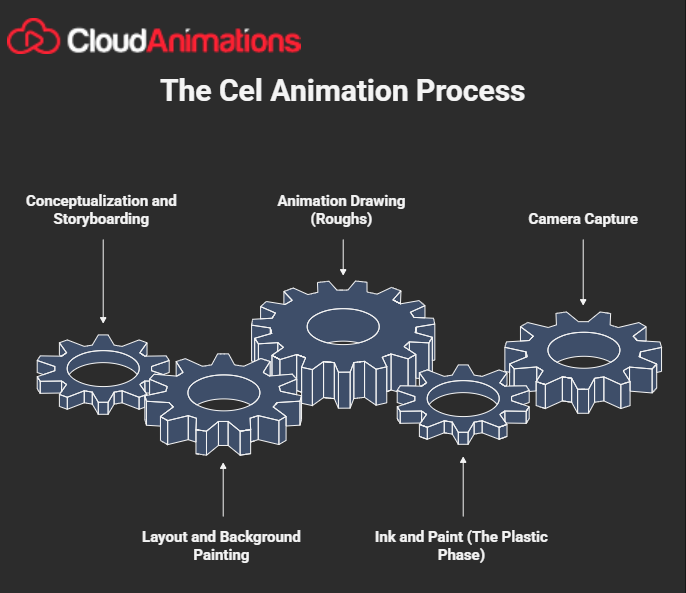
To appreciate the “soul” of this medium, you have to understand the sheer volume of work involved in the cel animation process. It was a factory-style operation that required surgical precision at every step.
1. Conceptualization and Storyboarding
Every project begins here. Before a single sheet of plastic is touched, the story is mapped out in rough sketches. This determines the timing, the “acting” of the characters, and the overall flow of the piece.
2. Layout and Background Painting
While the characters are drawn on transparent cels, the backgrounds are painted on thick paper or board, usually using gouache or acrylics. Because the background doesn’t move, it can be incredibly detailed. A single background might be used for an entire minute of footage while dozens of cels are swapped over it.
3. Animation Drawing (Roughs)
The lead animators first draw the character’s movement on paper. These are the “keys” and “breakdowns” we discussed in previous guides. They use lightboxes to ensure the character remains consistent from one frame to the next.
4. Ink and Paint (The Plastic Phase)
Once the pencil drawings are approved, they are transferred onto the celluloid. This is where the term 2d cel animation becomes literal.
- Inking: An artist (often called an “inker”) traces the pencil lines onto the front of the cel using black ink.
- Painting: The cell is then flipped over. The colors are painted on the back of the cel. This ensures that the black ink lines on the front stay crisp and don’t get covered by the paint. This is why cel animation examples from the classic era have those perfectly flat, bold colors and sharp outlines.
5. Camera Capture
The finished cels are placed over the background on a specialized camera stand. A heavy sheet of glass is pressed down to keep the cels perfectly flat and eliminate shadows between the layers. The camera takes one shot. The cels are swapped for the next frame, and the process repeats.
The Modern Evolution of Style
The look of traditional cel animation is iconic, but manual labor is a thing of the past. At Cloud Animations, we specialize in capturing that classic, organic feel using modern technology. Our digital cel animation workflows give you the warmth and character of the golden age without the prehistoric timelines.
The Digital Shift: What is Digital Cel Animation?
As we moved into the late 1990s, the physical plastic sheets began to disappear. The Little Mermaid (1989) was the last central Disney feature to use the traditional ink-and-paint process. Since then, we have transitioned to digital cel animation.
In this modern cel animation process, the “cels” are virtual. Artists draw directly into software using digital tablets. The “ink” is a vector or raster line, and the “paint” is a digital fill. However, the core logic remains the same. We still work in layers. We still separate the character from the background. We still focus on hand-drawn “keys.”
The advantage of the digital approach is the lack of physical constraints. In the old days, if you stacked more than five or six cels, the bottom layers would start to look dark or “milky” because the plastic wasn’t 100% transparent. In a digital environment, you can have hundreds of layers with perfect clarity. This has enabled hyper-detailed cel animation in multimedia, as seen in modern hits like Klaus and high-budget anime.

Mark Wilson
Mark is a Senior Content Marketer with 7+ years of experience in growing B2B, B2C, e-commerce, SaaS, & Digital Design Brands. He’s a polished writer, SEO geek, optimist at heart & good at playing table tennis.
Get the week’s best
marketing content

Use Cases: Why Choose Cel Animation Today?
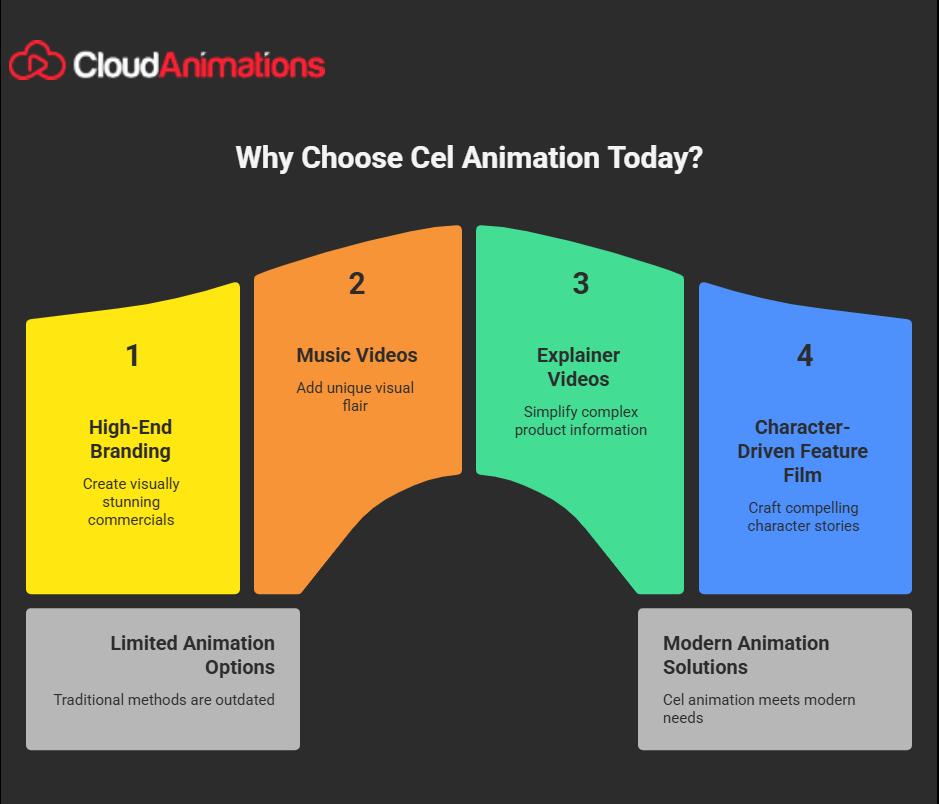
With 3D animation being so dominant, you might wonder why cel animation still matters. The reality is that for certain types of storytelling, 2D remains the superior choice.
1. High-End Branding and Commercials
Brands that want to feel “premium” or “bespoke” often turn to 2d cel animation. It suggests a level of craftsmanship that generic, “puppet-based” motion graphics can’t match. It feels intentional. When a character is drawn frame-by-frame, every movement is a creative choice, not a software calculation.
2. Music Videos
The music industry has a long love affair with this style. From the rotoscoped look of A-ha’s “Take On Me” to the Gorillaz, cel animation examples in music videos allow for a psychedelic, surrealist edge that 3D often struggles to replicate.
3. Explainer Videos for Complex Products
When you need to explain a complex software or a medical process, cel animation in multimedia allows for “selective realism.” You can simplify the visuals to focus only on the important parts, using the fluid motion to guide the viewer’s eye exactly where it needs to be.
4. Character-Driven Feature Films
Anime is the biggest proponent of this style today. Studios like Ghibli or MAPPA continue to push the boundaries of what is possible with the layered, hand-drawn approach. They prove that the “weight” and “impact” of a hand-drawn fight scene have a visceral quality that 3D often lacks.
Reimagine Your Brand’s Visuals Today.
Whether you need a gritty, hand-drawn look or a clean, modern digital aesthetic, your animation should be as unique as your brand. Cloud Animations bridges the gap between traditional artistry and new-generation tech. We provide a bespoke cel animation service that turns your concepts into fluid, high-impact reality.
Iconic Cel Animation Examples Through the Decades
To truly understand the types of cel animation, you have to see them in action. Here are the benchmarks that defined the medium.
The Classic Era: Pinocchio (1940)
This is often cited as the technical peak of the traditional cel animation era. The water effects, the lighting in the whale’s belly, and the complexity of the character acting were decades ahead of their time. It utilized the Multiplane Camera to create a staggering sense of depth.
The Television Boom: The Flintstones (1960)
This represents “Limited Animation.” To save money for TV, studios like Hanna-Barbera used fewer drawings per second. They would often keep the body static and only move the mouth or the eyes. While less fluid, this style created a unique aesthetic that defined an entire generation of animated characters done with cel animation.
The Anime Revolution: Akira (1988)
Akira shattered the idea that 2D animation was just for kids. It featured a staggering level of detail in its backgrounds and utilized a record-breaking number of colors. The fluid, high-frame-rate action sequences remain the gold standard for cel animation examples in the action genre.
The Modern Hybrid: Spider-Man Into the Spider-Verse (2018)
Wait, isn’t this 3D? Technically, yes. But it uses a “digital cel” philosophy. The artists applied hand-drawn ink lines and halftone dots over 3D models to replicate the look of a printed comic book. It is the ultimate evolution of the cel animation process for the 21st century.
Techniques That Defined the Art of Cel Animation
The beauty of cel animation lies in the clever tricks artists used to overcome physical limitations.
- The “Smear” Frame: When a character moves too fast for the camera to catch, animators draw a single frame where the character is stretched out into a long, blurred shape. On its own, it looks like a mistake. At 24 frames per second, it creates the illusion of extreme speed and fluidity.
- Rotoscoping: This is the technique of tracing over live-action footage frame-by-frame. It results in an eerily realistic movement. It was used extensively in the early Disney films to ensure the human characters moved with believable weight and grace.
- Squash and Stretch: This is the most important of the “12 Principles of Animation.” It involves distorting a character’s shape (like a ball flattening when it hits the ground) to emphasize its mass and flexibility. In cel animation, this is done by hand, allowing for a level of expressive exaggeration that feels “bouncy” and alive.
- Cycles: To save time, animators create “loops” for repetitive actions like walking or running. They draw 8 or 12 frames of a walk, and then simply loop those cels as the background scrolls past behind them. If you have ever seen a character in an old cartoon run past the same lamp post three times, you have seen a cycle in action.
The Robots Vs. The Hands
To truly understand the divide between traditional cel animation and the burgeoning world of AI, you have to look at the difference between a fingerprint and a formula. Traditional animation is a grueling marathon of human intent. Every line in a cel animation sequence represents a deliberate choice made by an artist, a choice about weight, emotion, and timing. When you watch a hand-drawn character, you are essentially watching a high-speed flipbook of thousands of unique human decisions. It is “perfect” because of its humanity, including the subtle, organic imperfections that make the movement feel warm and tangible.
AI-generated animation, conversely, is an exercise in statistical probability. The AI isn’t “drawing”; it is predicting what the next set of pixels should look like based on billions of reference images. While the speed of AI is staggering, it is collapsing months of manual “ink and paint” into seconds, as it often lacks the “narrative logic” that defines the cel animation process. An AI might struggle to keep a character’s proportions consistent across a turn (the “shimmering” effect). In contrast, a human animator uses their internal understanding of 3D volume to keep the character “on-model.”
The “intellectual honesty” of the industry right now is acknowledging that AI is a tool, while cel animation is a craft. One provides efficiency, while the other provides a soul. For high-end brands, the choice comes down to whether you want a product that is “generated” or a story that is “authored.”
| Feature | Traditional Cel Animation | AI-Generated Animation |
| Creation Method | Hand-drawn frame-by-frame on physical or digital layers. | Prompt-based pixel prediction using neural networks. |
| Production Speed | Very Slow (Months to Years for a feature). | Ultra-Fast (Seconds to Minutes). |
| Consistency | High “On-Model” accuracy maintained by human artists. | Variable; often suffers from “shimmering” or morphing artifacts. |
| Intent | Every frame is a conscious creative choice. | Derived from patterns in training data; less “intentional.” |
| Cost | High (Requires large teams of specialized artists). | Low (Requires hardware and specific prompting skills). |
| Visual Feel | Organic, warm, and carries the “artist’s touch.” | Often looks hyper-real but can feel “uncanny” or hollow. |
An Art That Refuses To Die.
Why does cel animation refuse to die? In a world of AI and hyper-realistic 3D, the hand-drawn line still carries an emotional weight that is hard to quantify. It feels personal. It carries the “imperfections” of the artist’s hand, which ironically makes it feel more “perfect” to our human brains.
The cel animation history is not a story of a technology being replaced; it is a story of a style evolving. From the clear sheets of Earl Hurd to the digital tablets of today, the core goal remains the same: to create a character that feels like it has a soul.
For businesses and creators, the takeaway is simple. Don’t choose an animation style just because it is the “default.” Choose it because it supports your story. If your brand is about heritage, craftsmanship, or organic growth, the traditional cel animation aesthetic is a powerful way to communicate those values without saying a word.
Your Gateway to Timeless Motion
We have explored the layers, the history, and the grueling process that defines the world of cel animation. But at the end of the day, you aren’t looking for a history lesson; you are looking for a way to make your brand unforgettable.
Cloud Animations is a “new-generation” studio that respects the technical rigor of the past while mastering the tools of the future. We understand that a high-end cel animation service isn’t about being “old-fashioned”; it’s about providing a level of visual sophistication that automated systems simply cannot match.
We bring the “super-intelligent” approach to your 2D motion needs. We don’t just move characters; we engineer performances. Whether you need the fluid, hand-drawn warmth of a classic feature or a sharp, stylized digital production for your next marketing campaign, we have the pipeline and the passion to deliver.
We understand the power and the undertones of the ink line, the importance of the painted background, and the visceral impact of a perfectly executed smear frame. In a digital world crowded with “blah” content, we provide the robust, technically sound, and witty visual storytelling that gives your brand an authoritative voice.
Frequently Asked Questions (FAQs)
Q: Is cel animation still used today?
In its physical, celluloid-and-paint form, it is scarce and usually reserved for boutique artistic projects. However, the digital cel animation style, in which characters are hand-drawn frame by frame on computers, remains a major part of the industry, especially in anime, commercials, and high-end feature films.
Q: What is the difference between cel animation and 2D skeletal animation?
In cel animation, every frame is a unique drawing. In skeletal (or puppet) animation, a character is built from individual pieces (arms, legs, head) that are moved using a digital “skeleton.” Skeletal animation is faster and cheaper, but it lacks the fluid, transformative “squash and stretch” that makes cel animation look so organic.
Q: Why was cel animation so expensive?
The costs were due to manual labor. You needed a team of lead animators, assistant animators, in-betweeners, inkers, and painters. Then you had the physical costs of the celluloid, the paints, and the film processing. A single 20-minute episode could require over 15,000 individual hand-painted cels.
Q: Can I achieve a cel animation look with 3D models?
Yes. This is called “Cel Shading” or “Toon Shading.” It uses specialized rendering techniques to make a 3D model look flat, with bold outlines and simple color blocks. While it can look very close to the real thing, it often lacks the unique “jitter” and hand-drawn acting found in true traditional cel animation.
Q: How do I get started with digital cel animation?
You need a drawing tablet (like a Wacom or iPad) and software that supports frame-by-frame workflows. Procreate (on iPad), Adobe Animate, and TVPaint are the standard entry points. The focus should be on learning the “12 Principles of Animation,” as the software is just a tool to help you execute those foundational rules.
Get your Free 30 Minute strategy
session with an experienced digital animators
You Might Also Like

How Explainer Videos Help Businesses?


The Role of AR/VR in Interactive Storytelling for Children

Why Explainer Videos Are a Must-Have for B2C Sales?

Why Explainer Videos Are Effective?

Why Are Creative Explainer Videos for Internal Business Training and Communication Effective?

How Product Explainer Videos Boost Sales and Customer Understanding?
How AI Explainer Videos Are Transforming Complex Concepts into Simple Ideas Creative

What is the Role of Corporate Explainer Videos in Onboarding and Training?
Why Whiteboard Explainer Videos Are Perfect for Complex Ideas?
How do you find the best studio at low costs for explainer videos in the USA?
Give us your e-mail so
we can give you Update